Русский
Оставить заявку

Русский

Founders, contractors, studios: You can make the O‑1 work—even without a single W‑2 employer—if you choose the right petitioner model, build a credible itinerary, and keep compliance tidy. Here’s the plain‑English playbook.
TL;DR (Simple): If you need freedom to work with multiple clients, use an Agent petitioner and attach a specific, dated itinerary plus third‑party letters. If you haveone real employer, use the Employer model. Keep contracts, scopes, dates, and locations specific; update USCIS if material changes happen.
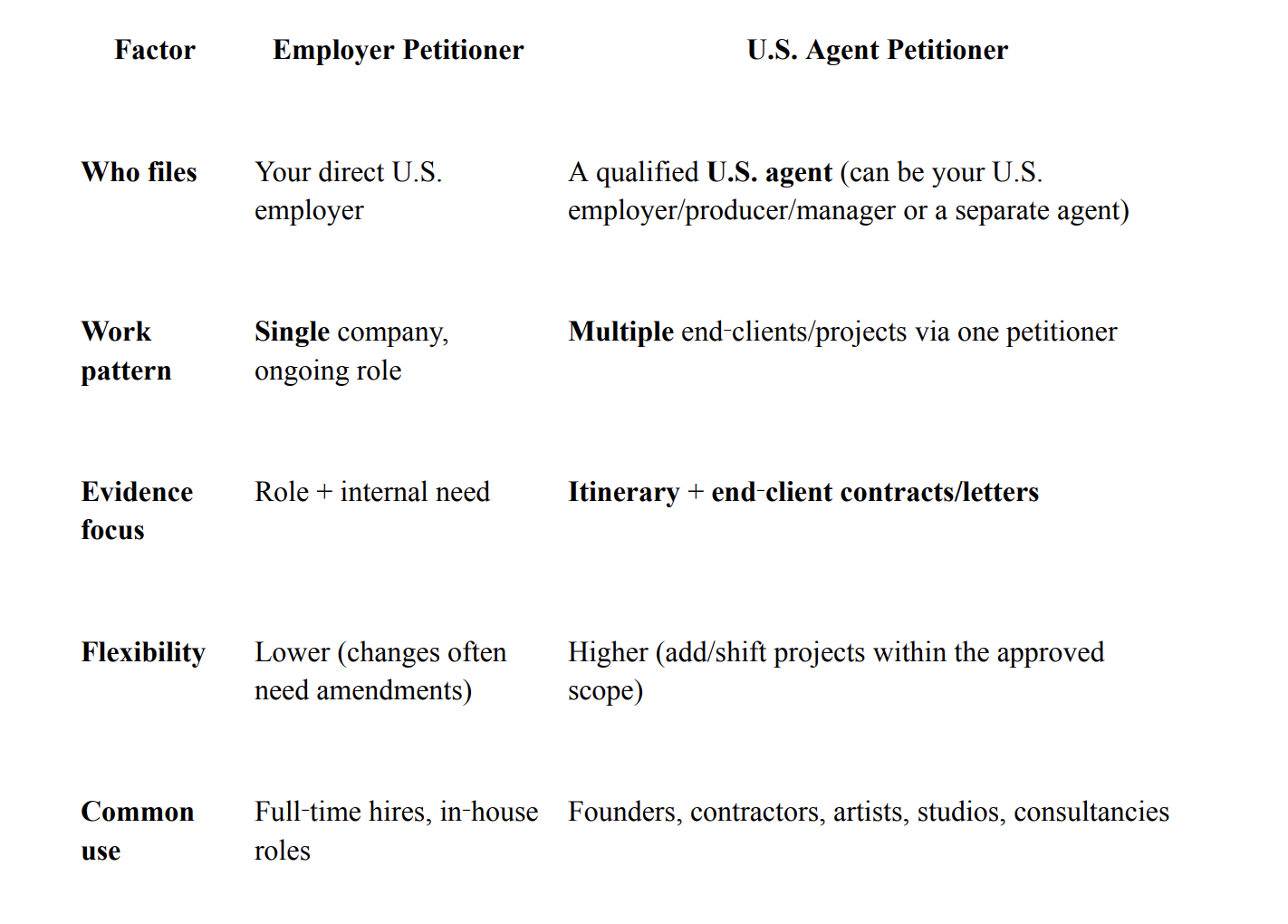
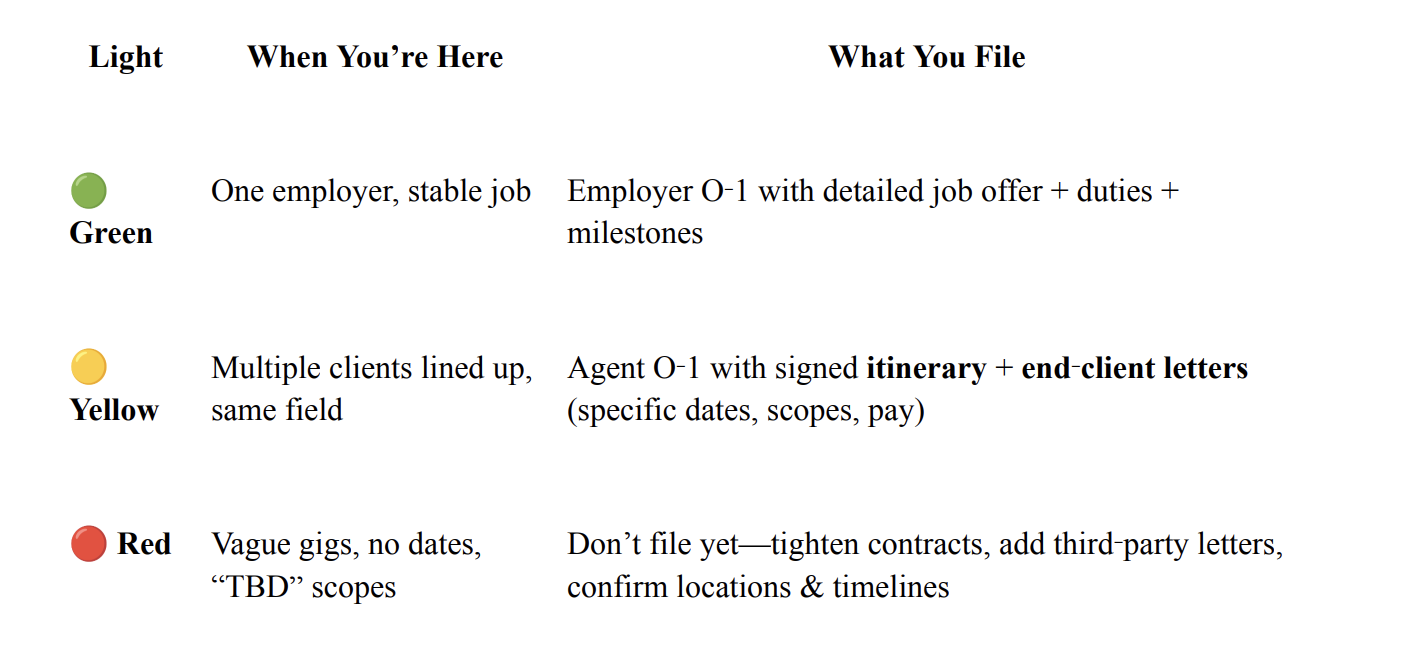
The Agent Model (Step‑By‑Step)
1. Pick the right agent type
○ Agent as employer (agency employs you directly) or
○ Agent for multiple employers (represents you for a roster of end‑clients).Both are viable—paperwork differs slightly.
2. Build a specific itinerary (cover the entire validity period)Include project name, end‑client, dates, location (city/state or remote), scope, andcompensation structure. Attach contracts/LOIs.
3. Collect third‑party letters (from end‑clients)Each should confirm: what you’ll do, when/where, why your skill is needed, and how you’ll be paid (directly or via the agent).
4. Map the work to O‑1 criteriaTie your role to critical capacity, original contributions, press, awards, peer review, high remuneration, etc. (quality > quantity).
5. Compliance kit (keep this ready)Master contracts, change‑log, pay records, calendar, and a simple material‑change checklist (see below).
The Employer Model (Done Right)
● Granular job description: duties, tools/tech, deliverables, and measurable milestones.
● Organizational evidence: who you report to, where you sit in the team, and why your skill is extraordinary relative to the role.
● Pay + benchmarks: W‑2 or salary letter + any equity details; add market comparators to show high remuneration.
Tip: If you anticipate consulting outside the employer, your petition must permit that or you’ll need amendments. Don’t improvise after approval.
What USCIS Expects to See (and What Triggers RFEs)
Must‑haves:
● Specifics (no “TBD”): dates, scopes, locations, deliverables, compensation
● End‑client confirmation when not a single employer
● Consistency across petition, contracts, letters, and your public profile
RFE magnets:
● Itinerary says “various projects” with no dates or addresses
● Contracts missing scope, term, or signatures
● Letters that praise you but don’t explain the engagement
● Big role changes post‑approval with no amendment
Material Change — When to Amend
Amend if there’s a significant change to what was approved:
● New employer/petitioner (switching from Agent to Employer or vice‑versa)
● Major shift in job duties, core field, or work location (e.g., moving states for a long period)
● Extended pause or cancellation of key projects that formed the basis of approval
Usually no amendment for:
● Minor date shifts within the same approved project window
● Adding a similar short project that fits the existing scope and timeframe (Agent model),if your petition text allows it
● Typical travel between listed locations
Practice move: Include language in the petition cover letter that anticipates similar projects under the same scope—this reduces amendment risk (but doesn’t eliminate it).
Founders & Studios — Common Structures That Work
● Agent for multiple clients → You deliver design/dev/production services to 3–6 named clients; agent invoices/collects; you’re paid per SOW.
● Agent as employer → The agency (your petitioner) employs you to serve its portfolio of clients; attach master contract + client addenda.
● Employer (startup) → The Delaware C‑Corp hires you as Creative/Technical Director; include board letter, cap table (if equity), salary, and roadmap milestones.
● Hybrid → Employer + narrow agent petition for discrete performances/exhibitions in the same field (advance planning required).
Evidence Map (Fast)
● Press & media (editorial, not paid)
● Peer review / juries / editorial boards
● Awards / major distinctions
● Original contributions with adoption/impact metrics
● Critical roles with outcomes
● High remuneration (salary, day‑rates, equity valuations)
We’ll pick your strongest 3–4 and build the rest around them.
Paperwork Templates (What to Prepare)
1. Master Itinerary (table covering the full validity period)Columns: Project, End‑Client, Dates, Location, Scope/Deliverables, Compensation
2. End‑Client Confirmation Letter (one page)Bullets: your role, dates, worksite, why you, how you’ll be paid, contact info +signature
3. Agent Agreement / Employment OfferTerms, responsibilities, payment flow, right to accept similar engagements in the samefield
4. Material‑Change ChecklistYes/No items: new petitioner? new state? new field? duties expanded 25%+? projectcancelled 60+ days? → amend
5. Compliance BinderPetition copy, contracts, letters, invoices, pay records, calendar, travel log
Mini‑Scenarios (How We’d File)
A) Startup CTO‑level Engineer doing fractional work
● Model: Agent for multiple employers
● Docs: Master itinerary + 4 client letters + rate cards + NDA redactions
● Note: Tie achievements to original contributions + peer review
B) Art Director with recurring brand campaigns
● Model: Agent as employer
● Docs: Agency employment letter + master services agreement + client addenda
● Note: Press + awards + high remuneration benchmarks
C) Film composer on two series + one feature
● Model: Agent for multiple employers
● Docs: Episode schedule, post locations, cue sheet milestones, third‑party confirmations
● Note: Performance rights statements + juried festivals
Common Pitfalls (And Fixes)
● Vague scopes → Replace with deliverables (e.g., “ship v1.0 iOS app by MM/DD, 5screens, analytics”)
● No dates → Add start/end windows (even ranges) per project
● Missing addresses → Provide city/state or production site; note remote when applicable
● No compensation detail → Add day‑rates/salary/equity terms (even if ranges)
● Silent on amendments → Add a one‑paragraph material‑change policy in the cover letter
Quick FAQ
Can I freelance for anyone once O‑1 is approved?
Only if your petition allows it (Agent model with itinerary) and the work stays within the approved field/scope.
Do I need signed contracts for every project?
Preferable. Where not possible, use LOIs + third‑party letters with specifics—and update with signed contracts ASAP.
Can my own U.S. company be the agent/employer?
Often yes, if it has real operations and someone other than you can sign as the petitioner. We’ll structure it properly.
When do I use premium processing?
When timing is tight or you need decisions for bookings; keep in mind RFE risk if the itinerary is thin.