Español
Enviar una solicitud

Español

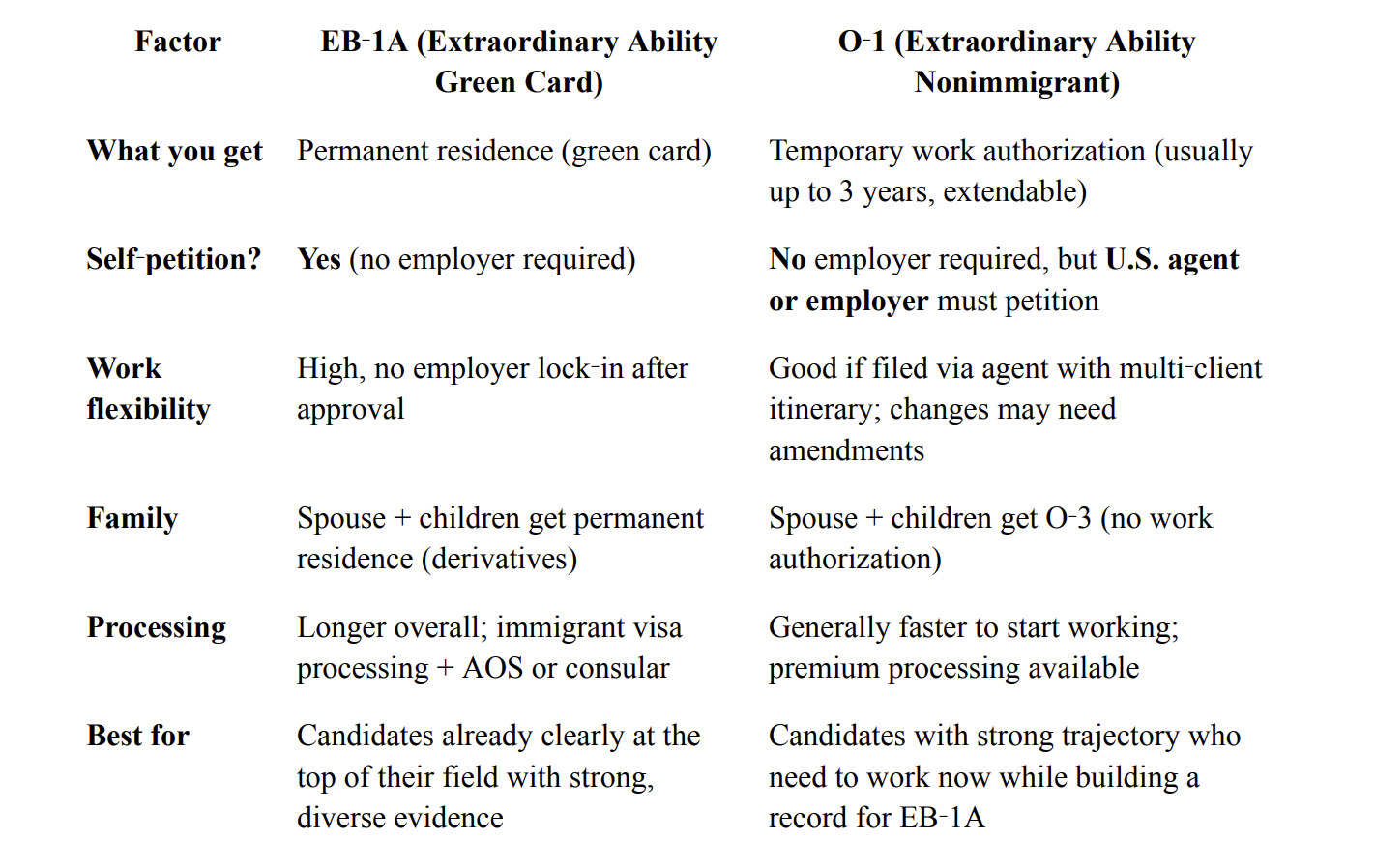
If you’re a high‑achieving founder, researcher, artist, or executive, should you start withO‑1 or aim straight for EB‑1A?
This guide breaks down what actually matters: eligibility, timelines, work flexibility, and the evidence you’ll need. Use the comparison, scenarios, and checklists below to choose a strategy that fits your goals
Evidence Map: What Counts (and Why)Both categories look for sustained acclaim at a high level. The strongest proof usually clusters around:
● Peer Recognition — judging others’ work (peer review, thesis/exam reviews, juries, editorial boards)
● Original Contributions of Major Significance — work that changed policy, practice, or industry outcomes; adoption/impact metrics
● Publications & Presentations — peer‑reviewed papers, conference keynotes, invited talks
● Media & Press — third‑party coverage in reputable outlets (not paid placements)
● Leadership/Critical Roles — leading roles in distinguished organizations; documented outcomes
● High Remuneration — compensation above market (benchmarks, contracts, equity valuation)
● Exhibitions/Showings/Performances (for creatives) — juried shows, festivals, museum/gallery records
Pro tip: The quality of evidence beats quantity. Independent, third‑party validation is more persuasive than internal letters alone.
Mini‑Scenarios: How We’d Decide in Practice
1) Anti‑corruption Prosecutor (Policy Impact)
● Profile: Multiple landmark cases; policy change credited to investigations; invited toreview doctoral theses.
● Path: Likely EB‑1A now (original contributions + judging + press). If some proofs arepending or need consolidation, consider O‑1 first while we curate a stronger impactdossier.
2) Senior Software Engineer (Publications + Talks)
● Profile: Several trade/academic articles, conference presentations, peer reviews;compensation above market.
● Path: O‑1 bridge to secure work and gather more independent press and leadershipevidence; convert to EB‑1A within 6–12 months once impact metrics/press mature.
3) Designer/Art Director (Brand Collaborations)
● Profile: Work exhibited and used by notable brands; strong portfolio; press mentions.
● Path: O‑1 via agent with multi‑client itinerary; build press, juried shows, and awards;EB‑1A when third‑party recognition deepens.
For many top candidates, the most efficient path is two‑stage:
1. File O‑1 to start work quickly. Use an agent if you need multiple clients or startupflexibility. Premium processing can accelerate decisions.
2. Deliberately grow EB‑1A evidence. We run a 60–90‑day plan: secure peer‑reviews, lineup invited talks, obtain third‑party impact letters, gather compensation benchmarks, and place non‑paid trade coverage.
3. Convert to EB‑1A once the record reflects sustained acclaim with independent validation across multiple categories. Why it works: O‑1 gives you momentum and work authorization. The time is used to shape and document the story that EB‑1A requires.
Red Flags We Fix Early
● Letter‑heavy, proof‑light files. We replace generic letters with specific, verifiable achievements and independent corroboration.
● Paid press / advertorials. We favor reputable, editorially‑controlled outlets and industry citations.
● Leadership without outcomes. We connect titles to measurable impact (users, revenue, policy, awards, adoption).
● Compensation claims without context. We add market data, contracts, equity valuations, and comparator analyses.
● Creative portfolios without curation. We document juried selection, curators’ notes, or festival criteria.
FAQs (Plain English)
Do I need an employer for EB‑1A? No—EB‑1A is a self‑petition. For O‑1, a U.S. employer or agent files.
Can I work for multiple clients on O‑1? Yes, with the right agent structure and a documented itinerary. Material changes may require amendments.
Which is faster? O‑1 decisions are often faster to start; EB‑1A takes longer but rewards you with permanent residence.
What about my family? EB‑1A grants permanent residence to spouse/children. O‑3 dependents(of O‑1) cannot work.
What if my record is strong in some areas but thin in others? Consider O‑1 now, then intensify third‑party recognition and impact proofs for EB‑1A.
What to Do Next (Checklist)
If you think EB‑1A now:
● Map current evidence to at least 3+ strong categories with independent validation
● Gather third‑party media, peer‑review records, leadership outcomes, and compensation benchmarks
● Prepare a concise impact narrative tying achievements to industry outcomes
If you think O‑1 first:
● Choose employer vs. agent (founders/contractors often benefit from an agent model)
● Draft a multi‑client itinerary with contracts and third‑party confirmation letters
● Launch a 90‑day evidence sprint (peer reviews, invited talks, non‑paid press, curatedportfolio)